

Cloud computing is essentially a collection of different services provided by different companies.
Cloud can serve a wide range of functions over the Internet, such as storage from virtual servers, virtual applications, desktop application authorization, etc.
There are two main types of cloud computing model, based on service and deployment.
Cloud deployment models
you need to know about the four types of deployment.
Public Cloud
Public Cloud, is a type of hosting where cloud services are provided over a public-use network.
- Customers have no control over the location of the infrastructure.
- The cost is shared by all users and is either free or in the form of a licensing policy such as pay-per-user.
- Public clouds are ideal for organizations requiring management of the host application and the different applications used by users.
Private Cloud
Private Cloud, is a cloud infrastructure that is only used by one organization.
- It gives organizations greater control over security and data, which is backed up by a firewall and managed in-house.
- It can be hosted internally or externally.
- Private clouds are ideal for organizations with high security requirements, high management demands and high availability requirements.
Hybrid cloud
Hybrid Cloud uses both private and public clouds, but can remain separate entities.
- Resources are managed and can be provided either internally or by external suppliers.
- A hybrid cloud is ideal for scalability, flexibility and security.
- An example of this is that an organization can use the public cloud to interact with customers, while keeping their data secure via a private cloud.
Community Cloud
Community Cloud is an infrastructure that is mutually shared between organizations belonging to a particular community.
- Community members generally share similar issues of confidentiality, performance and security.
- An example of this is a community cloud in banks, the government in a country or commercial enterprises.
- A community cloud can be managed and hosted in-house or by a third-party provider.
- A community cloud is good for organizations working on joint ventures that need a centralized cloud computing capability to manage, build and run their projects.
Cloud service models
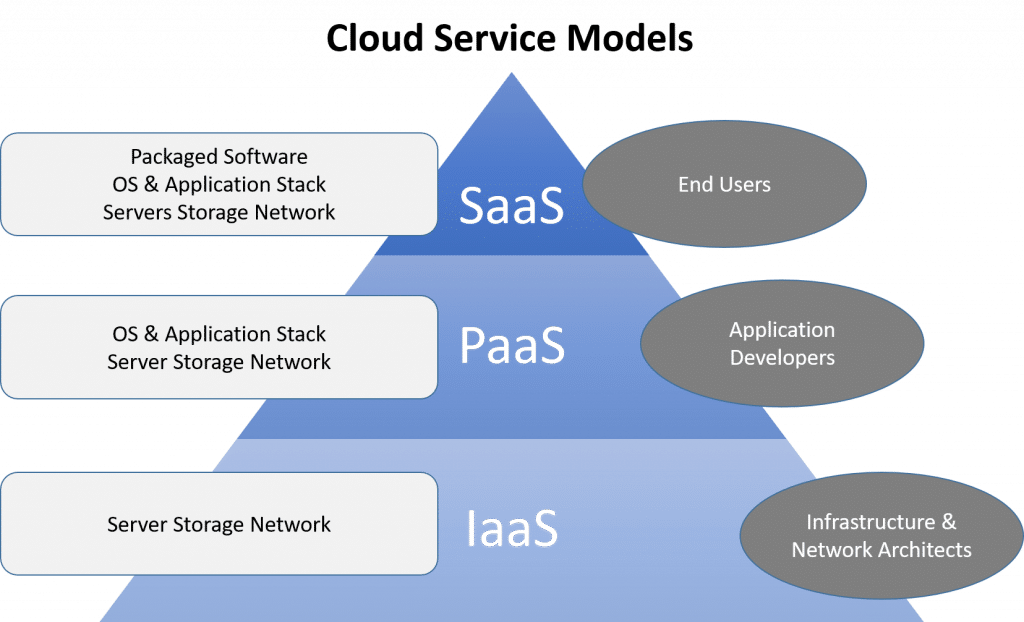
Cloud service models focus on delivering a certain type of offering to their customers.
Cloud Software as a Service
Cloud Software as a Service is a type of cloud that delivers an application to customers or organizations via a web browser.
- The application data runs on a server on the network, not on an application on the user’s computer.
- The software is generally sold on a subscription basis.
- Examples of SaaS are Salesforce, Google Docs, Office 365, Basecamp etc.
Cloud Infrastructure as a Service
Cloud Infrastructure as a Service, provides the hardware and operating system usually virtualized to their customers.
- Software is charged only for the computing power used, usually the CPU hours used in a month.
- Examples of IaaS are Amazon EC2, Rackspace, Google Compute Engine etc.
Cloud Platform as a service
Cloud Platform as a Service provides networked computers running in a hosted environment, and also adds support for the development environment.
- PaaS offerings typically support a specific program language or development environments.
- By deploying your application in this environment, you can take advantage of dynamic scalability and automatic database backups without needing to code specifically.
- PaaS is billed as an additional cost on top of the IaaS fee.
- Examples of PaaS are Google App Engine, Cloud Foundry, Engine Yard Etc.